
Kaplan-meier-based survival analysis of Cylas formicarius following exposure to stored Metarhizium anisopliae formulations
Article Sidebar
Main Article Content
Abstract
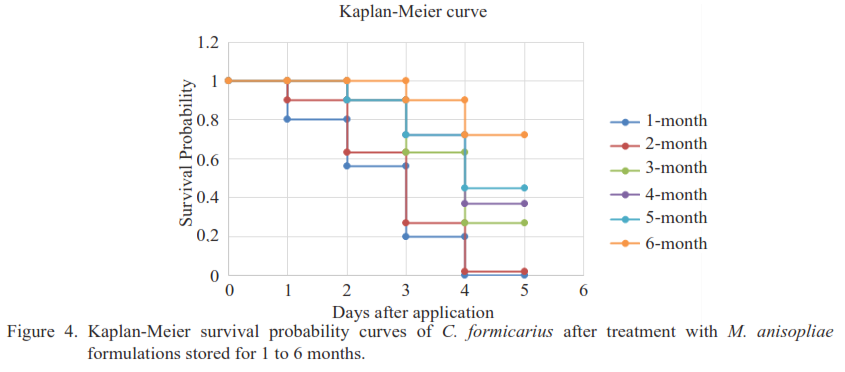
The sweet potato weevil (Cylas formicarius) is a major pest of sweet potato crops, particularly in tropical regions. The entomopathogenic fungus Metarhizium anisopliae is a promising biological control agent; however, its application is often constrained by reduced viability during storage. This study evaluated the efficacy of a dry powder formulation of M. anisopliae stored under ambient tropical conditions for 1 to 6 months. Bioassays assessed conidial density, adult mortality, lethal time to kill 50% of the population (LT₅₀), and survival probability using Kaplan–Meier analysis. Formulations stored for up to 3 months maintained high efficacy, with mortality rates exceeding 82.9%, conidial densities above 2.5 × 10⁸ conidia/g, and LT₅₀ values below 120 hours. In contrast, storage beyond three months significantly reduced conidial viability, increased LT₅₀, and decreased mortality. Kaplan–Meier survival curves showed a clear decline in virulence with increasing storage duration, with the 6-month formulation exhibiting the slowest mortality progression. Significant differences in survival probabilities among storage durations were confirmed statistically (p < 0.05). Morphological observations confirmed fungal-induced mortality, characterized by cuticle darkening, tissue softening, mummification, and external sporulation. Conidial deterioration over time was likely associated with physiological factors such as oxidative stress, lipid peroxidation, and depletion of protective compounds including trehalose and mannitol. Overall, storage duration critically affected the bioefficacy of M. anisopliae. It is therefore recommended that dry formulations be used within three months of production to ensure optimal pest control. These findings provide practical guidance for improving fungal biopesticide shelf life in tropical integrated pest management programs.
Article Details

This work is licensed under a Creative Commons Attribution-NonCommercial 4.0 International License.
Authors retain copyright of their published articles and grant the journal the right of first publication.
All articles published in Jurnal Hama dan Penyakit Tumbuhan Tropika: Journal of Tropical Plant Pests and Diseases are licensed under the Creative Commons Attribution-NonCommercial 4.0 International (CC BY-NC 4.0) license.
This license permits others to share, copy, distribute, and adapt the published work for non-commercial purposes, provided that appropriate credit is given to the original author(s) and the journal.
References
Baghi F, Gharsallaoui A, Dumas E, & Ghnimi S. 2022. Advancements in biodegradable active films for food packaging: Effects of nano/microcapsule incorporation. Foods. 11(5): 760. https://doi.org/10.3390/foods11050760
Chaithra M, Prameeladevi T, Bhagyasree SN, Prasad L, Subramanian S, & Kamil D. 2022. Multilocus sequence analysis for population diversity of indigenous entomopathogenic fungus Beauveria bassiana and its bio-efficacy against the cassava mite, Tetranychus truncatus Ehara (Acari: Tetranychidae). Front. Microbiol. 13: 1007017. https://doi.org/10.3389/fmicb.2022.1007017
Chen Y, Wan Y, Cai W, Liu N, Zeng J, Liu C, Peng H, & Fu G. 2022. Effects on cell membrane integrity of Pichia anomala by the accumulating excessive reactive oxygen species under ethanol stress. Foods. 11(22): 3744. https://doi.org/10.3390/foods11223744
Deka B, Babu A, Peter AJ, Kumhar KC, Sarkar S, Rajbongshi H, Dey P, Amalraj ELD, & Talluri VR. 2021. Potential of the entomopathogenic fungus, Metarhizium anisopliae s.l. in controlling live-wood eating termite, Microtermes obesi (Holmgren) (Blattodea: Termitidae) infesting tea crop. Egypt. J. Biol. Pest Control. 31: 132. https://doi.org/10.1186/S41938-021-00477-4
Elkhateeb WA, Mousa KM, ELnahas MO, & Daba GM. 2021. Fungi against insects and contrariwise as biological control models. Egypt. J. Biol. Pest Control. 31: 13. https://doi.org/10.1186/S41938-020-00360-8
Guo H, Xiong X, Wang Y, Tian H, Zhang S, & Geng G. 2022. Integrative proteomic and physiological analyses of the molecular response to dessication-stress in Auricularia fibrillifera. Front. Plant Sci. 13: 995810. https://doi.org/10.3389/fpls.2022.995810
Hughes KM, Price D, Torriero AAJ, Symonds MRE, & Suphioglu C. 2022. Impact of fungal spores on asthma prevalence and hospitalization. Int. J. Mol. Sci. 23(8): 4313. https://doi.org/10.3390/ijms23084313
Jeong SG, Kim HM, Kim J, Kim JS, & Park HW. 2022. Effect of storage conditions on the shelf-life extension of fungus-colonized substrates based on Metarhizium anisopliae using modified atmosphere packaging. Sci. Rep. 12: 423. https://doi.org/10.1038/S41598-021-04232-5
Khan FA, Ibrahim AA, & Zeki AM. 2020. Environmental monitoring and disease detection of plants in smart greenhouse using internet of things. J. Phys. Commun. 4(5): 055008. https://doi.org/10.1088/2399-6528/ab90c1
Kim HS, Lee CJ, Kim SE, Ji CY, Kim ST, Kim JS, Kim S, & Kwak SS. 2018. Current status on global sweetpotato cultivation and its prior tasks of mass production. J. Plant Biotechnol. 45(3): 190–195. https://doi.org/10.5010/JPB.2018.45.3.190
Kiruthiga G, Jeyarani S, Sathiah N, Murugan M, Sivakumar U, & Uma D. 2022. Pathogenicity, ultra-structural growth and development of green muscardine fungus, Metarhizium anisopliae (Metschnikoff) Sorokin (Ascomycota: Hypocreales) on maize fall armyworm, Spodoptera frugiperda (J. E. Smith) (Lepidoptera: Noctuidae). Egypt. J. Biol. Pest Control. 32: 97. https://doi.org/10.1186/s41938-022-00596-6
Lei Y, Hussain A, Guan Z, Wang D, Jaleel W, Lyu L, & He Y. 2021. Unraveling the mode of action of Cordyceps fumosorosea: Potential biocontrol agent against Plutella xylostella (Lepidoptera: Plutellidae). Insects. 12(2): 179. https://doi.org/10.3390/insects12020179
Liu D, Smagghe G, & Liu TX. 2023. Interactions between entomopathogenic fungi and insects and prospects with Glycans. J. Fungi. 9(5): 575. https://doi.org/10.3390/jof9050575
Mascarin GM, Golo PS, de Souza Ribeiro-Silva C, Muniz ER, de Oliveira Franco A, Kobori NN, & Fernandes ÉKK. 2024. Advances in submerged liquid fermentation and formulation of entomopathogenic fungi. Appl. Microbiol. Biotechnol. 108: 451. https://doi.org/10.1007/S00253-024-13287-z
Moeini A, Pedram P, Fattahi E, Cerruti P, & Santagata G. 2022. Edible polymers and secondary bioactive compounds for food packaging applications: antimicrobial, mechanical, and gas barrier properties. Polymers. 14(12): 2395. https://doi.org/10.3390/polym14122395
Ponijan P, Handayani EP, Kurniawati N, Rakhmiati R, & Zulkarnaen. 2023. Joint application of B. bassiana and M. anisopliae bioinsecticides for controlling rice bugs and improving rice yields. J. Trop. Plant Pests Dis. 23(2): 58–64. https://doi.org/10.23960/jhptt.22358-64
Prastowo S, Wardhani WK, Pradana AP, Wafa A, Addy HS, & Hadi ZFN. 2024. Metarhizium anisopliae Metsch. (Moniliales: Moniliaceae) and Aglaia odorata Lour. (Sapindales: Maliaceae) leaf extract: A potent biopesticide cocktail for cabbage leaf caterpillar management. J. Trop. Plant Pests Dis. 24(2): 212–222. https://doi.org/10.23960/jhptt.224212-222
Ratajczak K, Staninska-Pięta J, Czarny J, Cyplik P, Wolko Ł, & Piotrowska-Cyplik A. 2022. Effect of processing treatment and modified atmosphere packing on carrot’s microbial community structure by Illumina MiSeq sequencing. Molecules. 27(9): 2830. https://doi.org/10.3390/molecules27092830
Reddy GVP, Zhao Z, & Humber RA. 2014. Laboratory and field efficacy of entomopathogenic fungi for the management of the sweetpotato weevil, Cylas formicarius (Coleoptera: Brentidae). J. Invertebr. Pathol. 122: 10–15. https://doi.org/10.1016/j.jip.2014.07.009
Řepka D, Kurillová A, Murtaja Y, & Lapčík L. 2023. Application of physical-chemical approaches for encapsulation of active substances in pharmaceutical and food industries. Foods. 12(11): 2189. https://doi.org/10.3390/foods12112189
Rovira P, Brugnini G, Rodriguez J, Cabrera MC, Saadoun A, de Souza G, Luzardo S, & Rufo C. 2023. Microbiological changes during long-storage of beef meat under different temperature and vacuum-packaging conditions. Foods. 12(4): 694. https://doi.org/10.3390/foods12040694
Saputro TB, Prayogo Y, Rohman FL, & Alami NH. 2019. The virulence improvement of Beauveria bassiana in infecting Cylas formicarius modulated by various chitin based compounds. Biodiversitas. 20(9): 2486–2493. https://doi.org/10.13057/biodiv/D200909
Schloemer CM, Graham SH, & Lawrence KS. 2025. Sweetpotato pest challenges and management options. J. Integ. Pest Manag. 16(1): 4. https://doi.org/10.1093/jipm/pmaf003
Shemesh H, Bruns TD, Peay KG, Kennedy PG, & Nguyen NH. 2023. Changing balance between dormancy and mortality determines the trajectory of ectomycorrhizal fungal spore longevity over a 15-yr burial experiment. New Phytol. 238(1): 11–15. https://doi.org/10.1111/NPH.18677
Subagiya, Himawati MK, & Wulandari P. 2009. Pengujian toksisitas ekstrak daun wedusan (Ageratum conyzoides) terhadap ulat jantung kubis (Crocidolomia binotalis Zeller) [Toxicity Assessment of Wedusan Leaf Extract (Ageratum conyzoides) Against the Cabbage Heart Caterpillar (Crocidolomia binotalis Zeller)]. Caraka Tani. 24(2): 164–169
Teixidó N, Usall J, & Torres R. 2022. Insight into a successful development of biocontrol agents: Production, formulation, packaging, and shelf life as key aspects. Horticulturae. 8(4): 305. https://doi.org/10.3390/horticulturae8040305
Williams TJ, Gonzales-Huerta LE, & Armstrong-James D. 2021. Fungal-induced programmed cell death. J. Fungi. 7(3): 231. https://doi.org/10.3390/jof7030231
Wu H & Wong JWC. 2022. Temperature versus relative humidity: Which is more important for indoor mold prevention?. J. Fungi. 8(7): 696. https://doi.org/10.3390/jof8070696
Zhang X, Meng Y, Huang Y, Zhang D, & Fang W. 2021. A novel cascade allows Metarhizium robertsii to distinguish cuticle and hemocoel microenvironments during infection of insects. PLoS Biol. 19(8): e3001360. https://doi.org/10.1371/journal.pbio.3001360
Zhu X, Wang Y, Wang X, & Wang W. 2022. Exogenous regulators enhance the yield and stress resistance of chlamydospores of the biocontrol agent Trichoderma harzianum T4. J. Fungi. 8(10): 1017. https://doi.org/10.3390/jof8101017
Zulfiana D, Zulfitri A, Lestari AS, Krishanti NPRA, & Meisyara D. 2020. Production of conidia by entomopathogenic fungi and their pathogenicity against Coptotermes sp. Biosaintifika. 12(1): 1–9. https://doi.org/10.15294/biosaintifika.v12i1.22435